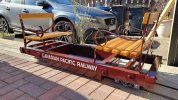
Wow, such a lot to think about now! The more I look at that original photo, the more I am convinced that an expanding mesh
was used! There does appear to be a distinct, rolled edge visible - at least on the inner side... although admittedly it is not so clear on the outer. I do wonder if that material was contained by a rolled over frame of some sort?!
I am probably overthinking this, (?) so for the moment it is back to the "cunning plan"!
Aluminium sheet we have a plenty, (salvaged from the demolished caravan body) so smooth plates will be no problem, but I would still like some sort of appropriate finish on the surface. A distinctly period, transport related solution does exist... and I had the opportunity to examine it closely during a recent visit to the East Anglian Transport Museum.
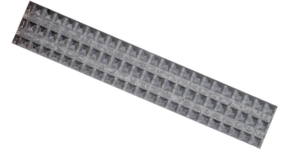
Unfortunately, being unaware of any future potential I didn't take any close-up, detail photographs at the time, but during a trawl yesterday I managed to find this example:
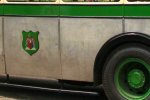 (Cropped from a copyright image published elsewhere, and shown here for illustrative purposes only)
Fish scale polishing was quite a popular feature at one time, although perhaps more commonly found in the early automotive industry. Whilst admittedly it is not historically accurate for our particular carriage, I nonetheless feel that it's application could be a very pleasing and traditional, period style embellishment?
Not only the ally, but a box of small, fairly course abrasive discs is to hand... and a simple, wooden jig could be built up on the drill press platter... so how hard could it be to have a go?
Famous last words I suppose?!
Pete.