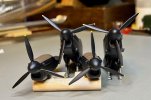
I'm now at the final assembly stage with the Airfix Lancaster:

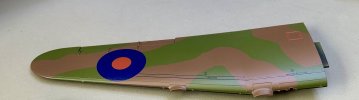
I'm quite pleased with the matt finish. I've brushed on Ronseal's Interior varnish (water-based, and it's never yet attacked or upset any transfers, of a wide variety of types) over transfers for some years now and while it's fairly easy to get a decent finish on the shapes and sizes of my more usual builds, 4mm scale railway vehicles, and to live with slight striping if it occasionally occurs, the larger flat areas on a thing like this just won't do in anything other than an even level of matt. After some testing, I've now found that an even, reasonably generous but not flooded coat of Halfords' Matt Lacquer, on top of the Ronseal, flattens everything down to an even matt. I also know from experience that the Halfords' lacquer shouldn't be sprayed directly onto transfers (don't ask how I know) so this combination seems quite useful.
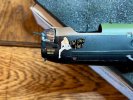
For the mid-fuselage gun turret and the main cockpit canopy, both of which need the metal framework painted to match the green and brown camouflage, I thought I'd have a go at mixing some of the Tamiya acrylic range to match the aircraft colours aerosols from their range that I'd used for the main colours (AS-9 Dark Green (RAF) and AS-22 (Dark Earth RAF). I've tried this once or twice before - matching aerosol colours by mixing brushed paint from pots - without great success and sure enough, the results weren't good! Typical recipes I found online were 1 part XF-58 (Olive Green) to 5 parts XF-62 (Olive Drab) for the green, and a 1:1 mix of XF-52 (Flat Earth) and XF-64 (Red Brown) for the brown. Even allowing for the different opacity and coat thickness from brushed paint as opposed to aerosol - something that can be compensated for and partially hidden) these didn't seem good matches to me: has anyone else tried these proportions, or found something better, for next time?
In the end, I went back to the technique I've used with enamel aerosols, of spraying quite a prolonged burst into the can's cap, enough to form a pool about 2-3mm deep if the cap's held at 45 degrees, then brushing it on with a 10/0 or 00000 brush, dipped, cleaned off and dried in cellulose thinners every few minutes. It worked better than I thought it might with acrylic aerosol, but the same things apply as when brushing aerosol paint. The small amount captured in the can top starts to cure very quickly, so you have to have everything set up to walk straight from (in my case outdoor) spraying to painting (including the lighting, magnification etc), and just like using a lining pen, you have to accept you'll only get a little done with each load of paint, because trying to do too much leads to trying to use half-cured paint. All this means it takes a long time, but the great advantage is of course that the colours match exactly: